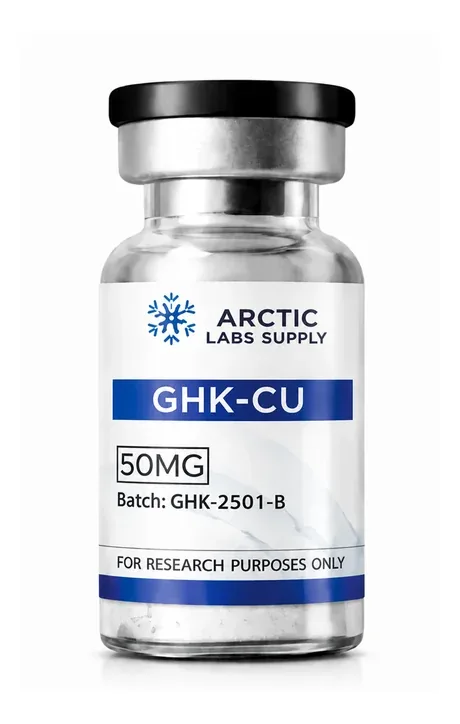
 GHK-Cu 50mg$38.99Lot GHK-2501-B · 99.03% HPLC · third-party report publishedView listing & add to cart
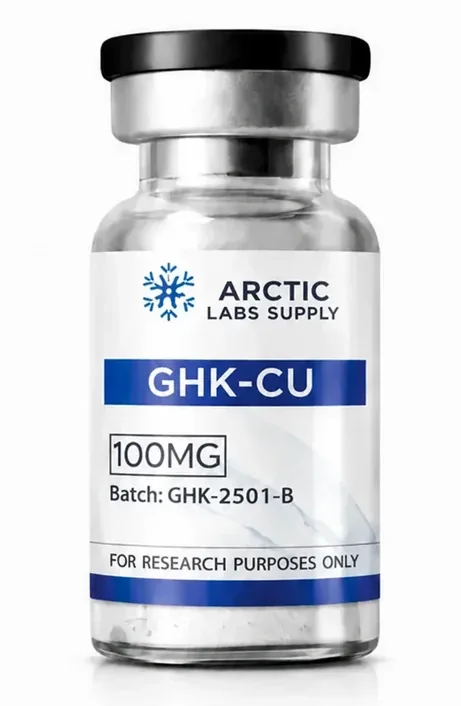 GHK-Cu 100mg$49.99Sealed vial · batch record on the listingView listing & add to cart
Identity
| Field | Value |
|---|---|
| Material | GHK-Cu |
| CAS number | 49557-75-7 |
| Molecular formula | C14H24CuN6O4 |
| Molecular weight | 403.9 g/mol |
| Form | Lyophilized powder in a sealed vial |
GHK-Cu is the copper(II) complex of the tripeptide glycyl-L-histidyl-L-lysine (CAS 49557-75-7, C14H24CuN6O4, 403.9 g/mol), supplied as a lyophilized powder in a sealed vial at 50 mg.
Listings by strength
| Strength | Price | Batch documentation | Listing |
|---|---|---|---|
| 50mg | $38.99 | Lot GHK-2501-B — 99.03% (HPLC), tested Aug 10, 2026 — batch report | GHK-Cu 50mg |
| 100mg | $54.99 | See listing for current status | GHK-Cu 100mg |
Published batch documentation
- GHK-Cu 50mg — lot GHK-2501-B: reported result 99.03% (HPLC), tested Aug 10, 2026, certificate COA-2026-8T-M1B, laboratory verification
About this material
GHK-Cu is the copper(II) complex of the tripeptide glycyl-L-histidyl-L-lysine. Arctic Lab Supply lists it under CAS 49557-75-7 as a lyophilized powder in a sealed glass vial, in the strengths shown above, with the lot number on every label. The characteristic blue colour of the lyophilized material comes from the copper complex; the free tripeptide (GHK, without copper) is a different material with a different CAS number and a different report.
A complete report on GHK-Cu has to establish both the peptide and the metal. The HPLC section addresses the tripeptide's purity by area percent. The mass-spectrometry section is more nuanced than for a plain peptide, because the complex can be observed as the free tripeptide, as the copper adduct, or as both, depending on the ionisation conditions; a good report states which species was observed and reconciles it with the theoretical mass. Where a lot's copper content is reported separately, that figure is on the batch record.
Two lots of this family are documented on this site, which makes it a useful place to see how lot-to-lot comparison works on paper: same material, same method family, two separate reports. The comparison guide linked below walks through both.
Choosing a strength
The 50 mg and 100 mg listings are the same material at different nominal quantities and are not different grades. Because GHK-Cu is hygroscopic, the net peptide content and water lines on the certificate matter more than for most peptides when reconciling the label quantity with the material in the vial. Match the vial's lot number to the record before use.
How to verify a vial against its record
- Read the lot number printed on the vial label.
- Open the batch record for that lot from the list on this page or from the COA library.
- Check that the identity section states which species was observed (free tripeptide, copper complex, or both) and that the observed mass matches the stated theoretical value.
- Confirm the certificate number with the issuing laboratory using the verification link on the record (how to verify a certificate).
- Compare the two published lots side by side using the comparison guide; differences in retention time between reports usually reflect method differences, not material differences.
Related reading
Common questions
- Is GHK-Cu the same as GHK?
- No. GHK-Cu (CAS 49557-75-7) is the copper(II) complex of the tripeptide; GHK is the free tripeptide. They carry different CAS numbers, different theoretical masses, and different reports.
- Why is the lyophilized powder blue?
- The colour comes from the copper(II) complex. It is a visual property of the material as supplied, not a measure of purity; the report is.
- What does the mass-spectrometry section look like for a metal complex?
- The laboratory may observe the free tripeptide, the copper adduct, or both. A complete report states which species was observed and reconciles it with the theoretical mass rather than leaving the reader to guess.
- Are the 50 mg and 100 mg vials different grades?
- No. They are the same material filled to different nominal quantities. The lot number on the label identifies the batch record that applies.
- How do I compare two lots?
- Open both batch records and compare the identity result, the area-percent purity, and the stated method. The lot-comparison guide linked on this page walks through the two lots published here.
- How do I confirm the certificate is genuine?
- Each batch record links to the issuing laboratory's verification page and certificate number. Confirming there is the step that makes the report independent of this site.
What a batch report does and does not establish
A published report describes one sample from one lot on one date under the stated method. It supports the identity and chromatographic purity result it lists. It does not describe other lots, and it says nothing about attributes that were not tested. Match the lot on the vial label to the lot on the report before relying on it (how to match a vial to its record).