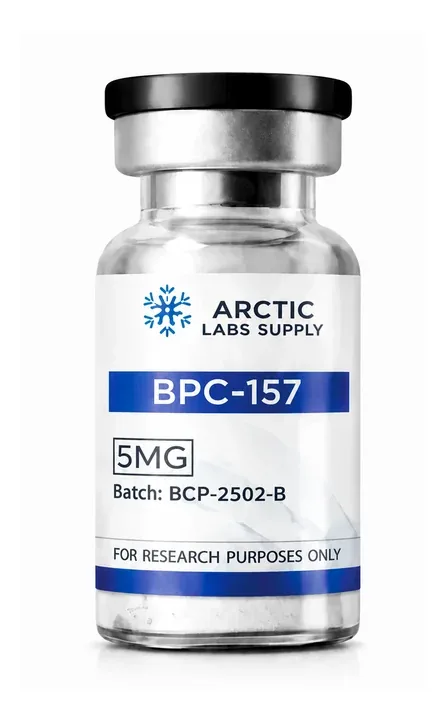
 BPC-157 5mg$24.99Lot BCP-2502-B · 99.59% HPLC · third-party report publishedView listing & add to cart
 BPC-157 10mg$44.99Sealed vial · batch record on the listingView listing & add to cart
Identity
| Field | Value |
|---|---|
| Material | BPC-157 |
| CAS number | 137525-51-0 |
| Molecular formula | C62H98N16O22 |
| Molecular weight | 1419.5 g/mol |
| Form | Lyophilized powder in a sealed vial |
BPC-157 is a synthetic 15-amino-acid pentadecapeptide (CAS 137525-51-0, C62H98N16O22, 1419.5 g/mol) supplied as a lyophilized powder in a sealed 5 mg vial.
Listings by strength
| Strength | Price | Batch documentation | Listing |
|---|---|---|---|
| 5mg | $39.99 | Lot BCP-2502-B — 99.59% (HPLC), tested Aug 25, 2026 — batch report | BPC-157 5mg |
| 10mg | $59.99 | See listing for current status | BPC-157 10mg |
Published batch documentation
- BPC-157 5mg — lot BCP-2502-B: reported result 99.59% (HPLC), tested Aug 25, 2026, certificate COA-2026-Q53ZYU, laboratory verification
About this material
BPC-157 is a synthetic pentadecapeptide: fifteen amino-acid residues (Gly-Glu-Pro-Pro-Pro-Gly-Lys-Pro-Ala-Asp-Asp-Ala-Gly-Leu-Val) assembled by solid-phase synthesis, cleaved from the resin, and purified by reversed-phase chromatography. Arctic Lab Supply lists it under CAS 137525-51-0 as a lyophilized (freeze-dried) powder in a sealed glass vial, in the strengths shown above. Every vial is labeled with the lot number that ties it to the batch record on this page.
Because the sequence contains three consecutive prolines and two adjacent aspartic acids, a complete report on this material has to show two things at once: that the mass-spectrometry section matches the theoretical monoisotopic mass of the full 15-residue chain, and that the HPLC trace does not carry a significant deletion-sequence peak next to the main peak. Deletion sequences (a chain missing one residue) are the most common synthesis impurity on a peptide of this length, and they elute very close to the parent. That is why the chromatogram, not just the purity percentage, is published for each lot.
The number on the label is the nominal quantity of peptide material in the vial. It is not the same as gross fill weight, because a lyophilized peptide is supplied as a salt (usually trifluoroacetate or acetate) with bound water. The net peptide content line on the certificate, when reported, is the figure that reconciles the two. Our guide on net peptide content explains how to read that line.
Choosing a strength
The 5 mg and 10 mg listings are the same material from the same synthesis route, filled to different nominal quantities. They are not different grades. A lot may be filled at one strength or both; when both strengths come from the same lot, the batch record is shared and the lot number on the vial is the way to tell. Choose by the quantity your laboratory's analytical or in-vitro protocol consumes, and match the vial's lot number to the record before use.
How to verify a vial against its record
- Read the lot number printed on the vial label.
- Open the batch record for that lot from the list on this page or from the COA library.
- Confirm the report's identity section (observed mass against the theoretical mass) and its purity section (HPLC area percentage with the method stated).
- Use the laboratory's own verification link on the record to confirm the certificate number with the issuing lab, as described in verifying a certificate.
- If the lot on the vial is not on this page, contact support with the lot number before relying on the material; records are never removed when a batch sells out, so an unlisted lot is a question worth asking.
Related reading
Common questions
- Is the 10 mg vial the same material as the 5 mg vial?
- Yes. Both strengths are BPC-157 (CAS 137525-51-0) from the same synthesis route, filled to different nominal quantities. The lot number on the label identifies the batch record that applies.
- What should the mass-spectrometry section show for BPC-157?
- An observed mass consistent with the theoretical mass of the full 15-residue sequence (C62H98N16O22, about 1419.5 g/mol), within the tolerance the laboratory states. A mass that is short by the weight of one residue points to a deletion sequence.
- Why is the HPLC purity not 100%?
- Area-percent purity reports the main peak's share of the total detected peak area under one method. Residual synthesis-related peptides, counter-ion and water are not the main peak, so a well-made lot reports in the high 90s rather than 100. The published trace shows where the remainder sits.
- Does the report cover every vial in the lot?
- It describes one sample from the lot, tested on one date under the stated method. It supports the identity and purity result it lists for that lot; it does not describe other lots and says nothing about attributes that were not tested.
- How do I confirm the certificate is genuine?
- Each batch record links to the issuing laboratory's verification page and certificate number. Confirming there, rather than on this site, is the step that makes the report independent.
- Where is the material shipped from?
- Anchorage, Alaska, with tracking on every order. Free U.S. shipping applies from $99.
What a batch report does and does not establish
A published report describes one sample from one lot on one date under the stated method. It supports the identity and chromatographic purity result it lists. It does not describe other lots, and it says nothing about attributes that were not tested. Match the lot on the vial label to the lot on the report before relying on it (how to match a vial to its record).